Startup Accelerators - Are They Worth the Hype in Australia? The Real Pros and Cons of Startmate, Antler, TS, Latitude 37 and the New Founder Economy
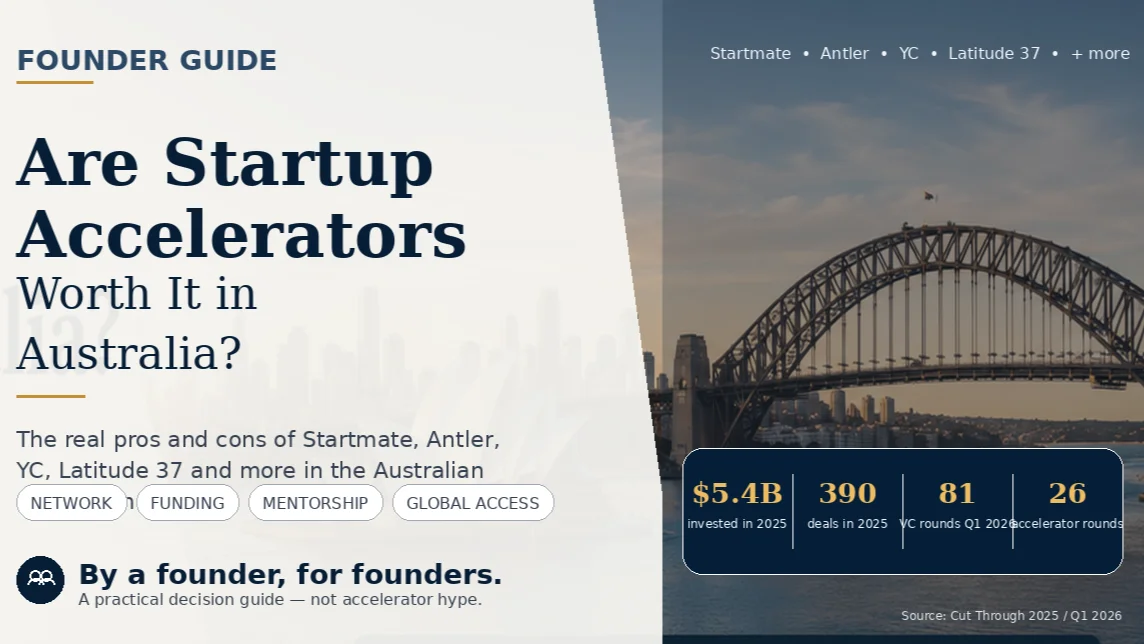
Startup accelerators have become one of the most visible gateways into the startup world. For a first-time founder, they can look like a cheat code: capital (rarely equity free), mentors, investor introductions, pitch practice, a cohort of ambitious peers and, in some cases, the credibility of a logo that instantly changes how people respond to your emails.
In Australia, the accelerator landscape has matured well beyond the early stereotype of pizza nights, pitch decks and generic startup advice. Startmate has built one of the strongest founder networks in Australia and New Zealand. Antler has turned founder formation into an institutional model. Y Combinator remains the global status signal. University-backed programs such as UNSW Founders 10x help convert research and student talent into investable companies. Specialist programs like Catalysr, Cicada Innovations, Remarkable, LaunchVic-supported pre-accelerators and climate, health, AI and deep tech pathways are filling gaps that traditional venture capital often misses. Airwallex’s Latitude 37 adds a newer model: equity-free capital and global exposure for young Australian AI founders.
That variety is good news. It also makes the decision harder.
The real question is not “Are accelerators good?” It is: is this accelerator the right tool for this founder, this company, this stage and this cap table?
What Accelerators Really Sell
Accelerators do not just sell money. In many cases, the cheque is not even the main product.
What they sell is compression.
They compress learning by putting you around people who have seen your problems before. They compress trust by lending you their brand. They compress network-building by replacing cold outreach with warm introductions. They compress founder development by forcing uncomfortable conversations about customers, pricing, positioning, fundraising and whether anyone actually wants what you are building.
That is valuable in Australia because our startup market has always had a strange duality. We have world-class talent, strong universities, ambitious operators and companies that think globally from day one. But we also have a smaller domestic market, thinner pools of early-stage capital compared with the US, fewer repeat founders at scale, and a tendency for promising companies to look offshore earlier than they might like.
A good accelerator can help close that gap. A poor-fit accelerator can make it worse.
The upside: why accelerators can be worth it
1. They turn isolation into momentum
The earliest stage of a startup is lonely. You are usually pre-revenue, pre-product-market fit, pre-confidence and surrounded by people who either do not understand what you are doing or think you are taking an irrational risk.
A strong accelerator changes the room.
Suddenly, you are around founders who are also chasing customers, shipping prototypes, rewriting their pitch and discovering that their first idea was probably not the right one. That energy matters. It creates accountability. It normalises rejection. It makes progress visible.
For solo founders especially, programs like Antler can be powerful because they tackle one of the hardest early decisions: who to build with. Co-founder matching is not magic, but a structured environment can reveal how people work under pressure far better than a few coffee chats.
2. They provide a credibility shortcut
In early-stage startups, credibility is oxygen.
A founder with no brand, no warm network and no previous exit can spend months trying to convince investors, customers and potential hires to take them seriously. An accelerator can transfer trust. A Startmate, Antler, Techstars, YC, UNSW Founders or Airwallex-backed program name will not build the company for you, but it can get your email opened.
This matters even more in Australia, where networks can be relationship-heavy and relatively small. A warm introduction from the right operator or investor can save weeks of dead ends.
3. They teach the craft of venture-backed company building
Many founders underestimate how specific the venture-backed path is.
It is not just “build a good business”. It is build a company that can grow fast enough, in a large enough market, with a credible enough path to outsized returns, to justify high-risk capital.
Accelerators often help founders understand that game: how to frame a market, how to speak to investors, how to run customer discovery, how to design experiments, how to price, how to create urgency and how to avoid building beautiful products nobody buys.
This does not mean every founder should become venture-backed. It means that if you are going to play that game, you should learn the rules early.
4. They create a peer network that compounds
The alumni network is often more valuable than the formal curriculum.
Your cohort might become your first customers, future investors, hiring referrals, product feedback group or emotional support system. The best programs create a sense of “founder density” that is hard to replicate alone.
This is where Startmate has been especially important in the Australian and New Zealand ecosystem. Its value is not just the cheque; it is the density of mentors, operators, alumni and investors around the founder.
YC operates at a different scale again. Its brand and alumni network are global. For founders building highly scalable software companies with international ambition, YC can function as a passport into the US venture market.
5. Equity-free and specialist programs can fill real market gaps
Not all valuable programs are traditional equity accelerators.
Latitude 37 is interesting because it recognises a painful truth: the earliest cheque can be the most expensive cheque a founder ever takes. Equity-free capital is rare and powerful because it lets founders buy time without selling ownership at the company’s weakest valuation point.
Specialist programs also matter. Catalysr supports migrant and refugee entrepreneurs who may not have inherited local networks. Cicada Innovations supports deep tech founders whose timelines, capital needs and commercialisation paths are very different from SaaS. UNSW Founders 10x helps translate university talent and research into startups. Remarkable focuses on disability tech. Climate and health accelerators can connect founders with domain experts, regulators, research partners and customers that generic startup programs may not understand.
This is the future of the ecosystem: not one accelerator to rule them all, but better matching between founder type and support model.
The downside: what founders should be careful about
1. Dilution is most expensive when you are earliest
The biggest cost of an accelerator is usually not the time. It is the equity.
A small cheque can look generous when you have nothing. But if the company works, early equity becomes extremely expensive. Giving up 7%, 8%, 10% or 12% before you know what you are building may be rational in some cases, but it should never be treated casually.
This is especially important for Australian founders because follow-on rounds can already be harder than in the US. If you give away too much too early, then raise again, then expand internationally, your cap table can become heavy before the company has real leverage.
The question is not “Is the cheque enough to survive?” The question is: does the program increase the value of the company by more than the ownership it takes?
Sometimes the answer is absolutely yes. Sometimes it is no.
2. Accelerators can push companies onto the wrong path
Not every startup should be a venture-backed startup.
Some companies are better as bootstrapped software businesses, agencies, services-led products, profitable niche platforms, local marketplaces, community businesses or slow-burn deep tech ventures. A traditional accelerator may unintentionally push founders towards the same playbook: raise, grow, hire, raise again, chase a massive market and optimise for investor appetite.
That can be dangerous.
A founder building a profitable vertical SaaS tool for a small but loyal market may not need venture capital. A climate hardware company may need grants, pilots and procurement pathways more than pitch coaching. A services-heavy AI business may need design partners and distribution, not a demo day.
Acceleration is only useful if you are accelerating in the right direction.
3. Mentor advice can become noise
Mentorship is one of the most marketed benefits of accelerators, but it can also be one of the most chaotic.
Founders can receive conflicting advice from investors, operators, domain experts and alumni within the same week. One mentor says narrow the market. Another says expand the vision. One says charge more. Another says remove friction and grow usage. One says build enterprise. Another says go self-serve.
Good founders learn to extract patterns without outsourcing judgement. Bad programs create mentor whiplash. Great programs help founders interpret advice, not just collect it.
4. Demo Day can distort priorities
Pitching is useful. Fundraising is important. But the company is not the pitch deck.
A common accelerator failure mode is that founders become better at explaining the business than improving the business. They optimise the narrative, polish the deck, rehearse the story and create the appearance of momentum while avoiding the harder work: talking to customers, closing revenue, fixing onboarding, improving retention and making the product indispensable.
This is not the fault of demo days alone. It is a broader startup culture problem. But accelerators can amplify it if the program rewards theatre over traction.
The best founders use demo day as a forcing function, not as the goal.
5. Standard terms may not fit non-standard companies
Standardised accelerator terms make programs easier to run, but founders are not standardised.
A pre-idea founder, a research spinout, a solo AI builder, a two-sided marketplace, a medical device startup and a revenue-generating SaaS company all have different risk profiles. Yet some programs apply broadly similar economics.
Founders should read the actual documents, not just the landing page. Understand SAFE caps, valuation, equity percentage, program fees, pro-rata rights, MFN clauses, clawbacks, marketing obligations, IP provisions, confidentiality, founder commitment rules and what happens if the company pivots.
The headline cheque is not the deal. The documents are the deal.
6. Prestigious programs can create false confidence
Getting into a top accelerator is a signal. It is not product-market fit.
The danger of prestige is that it can trick founders into thinking selection equals validation. It does not. It means a panel believed the founder, market or idea had potential. Customers still decide the truth.
This is particularly relevant in AI right now. Programs, investors and media are actively looking for AI-native companies. That can create opportunity, but also hype. If AI is genuinely central to the product, that is powerful. If it is a thin wrapper on a conventional workflow, founders may win attention before they earn retention.
The market eventually notices.
The Australian context: why accelerators matter here
Australia’s startup ecosystem is in an interesting moment.
Capital has returned, but not evenly. Investors are more selective. AI, vertical software, deep tech, hardware, robotics, space, defence, climate and health are attracting attention, but the bar for conviction is higher. At the same time, Australia’s tech sector has become a major economic engine, and the country has a growing base of experienced operators who can recycle knowledge into the next generation of companies.
Techstars also deserves a place in the Australian accelerator conversation. Through Techstars Tech Central Sydney, it brought a globally recognised, mentorship-driven accelerator model into the local ecosystem, backing early-stage founders with capital, structured coaching, investor access and international credibility. Its presence mattered because it gave Australian founders another bridge between the local market and the global startup network, sitting somewhere between the local density of Startmate and the international signalling power of YC. The recent uncertainty around the Sydney program also highlights a broader weakness in Australia’s ecosystem: too much early-stage support still depends on changing government priorities, rather than durable, founder-first infrastructure that compounds over decades.
This is exactly where accelerators can be useful.
They can help first-time founders understand what “fundable” really means. They can help researchers commercialise. They can help migrant, female, regional, young and underrepresented founders access networks they were not born into. They can help Australian startups think globally earlier.
But accelerators should not become a substitute for the harder structural work Australia still needs: more early customers, more government and corporate procurement, better R&D commercialisation pathways, more patient capital, better later-stage funding, stronger university-industry links and more founders with lived experience of scaling globally.
A healthy ecosystem does not just create more pitch nights. It creates more customers.
When you should apply
An accelerator is likely worth considering if you are early, ambitious and genuinely need compression.
Apply if you need a stronger founder network, are preparing to raise capital, want to pressure-test your market, need help with positioning, are ready to commit full-time, and believe the program’s network is directly relevant to your customers, investors or talent needs.
Apply if the brand will open doors you cannot open yourself.
Apply if the capital gives you enough runway to reach a meaningful milestone.
Apply if the mentors have actually built, bought, funded or scaled companies like yours.
And apply if you can clearly answer this: by the end of the program, what must be true for this to have been worth it?
That answer should be concrete: five enterprise pilots, $20k in monthly revenue, a technical co-founder, a signed design partner, a seed round, regulatory clarity, a working prototype, a repeatable outbound motion.
If the goal is just “exposure”, be careful.
When you should avoid one
Avoid an accelerator if the terms damage your cap table more than the program helps your company.
Avoid one if you are only applying because you want permission to start.
Avoid one if your business is better suited to bootstrapping, grants, revenue finance, customer-funded development or a slower path.
Avoid one if the mentor network is impressive but irrelevant.
Avoid one if the program requires so much pitching, travel or performance that it pulls you away from customers.
And avoid one if you are using it to delay the uncomfortable truth that the idea has not found demand.
No accelerator can rescue a founder from customer reality.
A founder’s due diligence checklist
Before signing anything, founders should ask:
What percentage of the company am I giving up now and on conversion?
Is the cheque gross or net of fees?
Are there program fees, clawbacks or repayment conditions?
Does the accelerator receive pro-rata rights, information rights or other investor protections?
What are the actual SAFE, valuation cap, MFN or equity terms?
Who specifically will mentor me, and how much time will I get with them?
Can I speak to alumni who did not become the poster children?
What happened to the last three cohorts?
How many companies raised after the program?
How many gained customers, not just investor meetings?
Does this program understand my sector?
Will this help me build, sell, hire or raise — and which matters most right now?
Founders should speak to at least three alumni: one who did extremely well, one who had an average experience and one who would not do it again. The third conversation is usually the most useful.
The verdict
Startup accelerators are neither saviours nor scams. They are leverage.
In the right hands, at the right stage, on the right terms, they can change the trajectory of a company. They can turn isolation into momentum, uncertainty into focus, cold networks into warm introductions and raw ambition into a sharper operating cadence.
But leverage cuts both ways.
A mismatched accelerator can dilute founders too early, pull attention away from customers, create performative momentum and push a company towards a venture path it was never suited for.
The smartest Australian founders will not ask, “Which accelerator is the most prestigious?”
They will ask, “Which program gives my company the unfair advantage it actually needs?”
For some, that will be YC and the global venture machine. For others, it will be Startmate and the ANZ founder network. For some, it will be Antler and the structure to find a co-founder and build from zero. For young AI founders, Latitude 37’s equity-free model may be uniquely attractive. For researchers, climate founders, health founders, migrant founders, disability tech founders or university spinouts, the best option may be a specialist program with fewer headlines but much better fit.
The future of the Australian startup ecosystem should not be a race to copy Silicon Valley accelerators. It should be a smarter, more diverse support system that helps founders choose the right path earlier — venture-backed when appropriate, bootstrapped when better, equity-free when possible, specialist when necessary and global from day one when the ambition demands it.
Acceleration is powerful.
But only if you are pointed in the right direction.
How easy can you decelerate if needed?
Disclosure: This article was drafted with assistance from ChatGPT Pro 5.5 using Extra High reasoning mode. The framing, edits, opinions, content embeds and final responsibility were added on my own.
Thanks for reading.
View the original discussion on LinkedIn ↗






Join the conversation
Comments and reactions use GitHub. Sign in to join in, and keep the discussion thoughtful and respectful.
View discussions on GitHub ↗