From Gig Work to Token Work: The Uberification of White-Collar Labour

A delivery rider waits outside a restaurant for the next order. A developer waits for their AI allowance to reset.
Their circumstances are very different. Losing access to paid deliveries is not the same as temporarily losing access to a coding assistant. But both situations raise a question worth asking: what happens when a platform controls something you increasingly need to earn a living?
Australia's gig workers have spent years fighting over that question. Their experience should matter to the developers, designers, analysts and other professionals now building their working lives around AI.
Uber arrived in Sydney in 2012. A new Australian minimum-standards order for covered app-based food and grocery delivery workers began operating on 17 August 2026. Those are different services and different milestones, but the span is striking: almost fourteen years between an early platform-work arrival and this particular regulatory protection. Uber's Australian history; Fair Work Commission announcement.
That change did not simply arrive because the technology matured. Workers organised. The Transport Workers' Union (TWU) pursued cases, campaigned for reform and applied for enforceable standards.
White-collar workers should pay attention to both the delay and the organising that helped end it.
Flexibility is valuable. Having a say over the rules is valuable too.
The promise was real: you could simply start working
Before discussing what went wrong, it is worth remembering what made gig work attractive.
Traditional recruitment puts a lot between wanting work and getting paid: advertisements, applications, screening, interviews, references, onboarding and rosters.
A platform could compress much of that into:
Sign up → get approved → go online → work.
The flexibility was also meaningful. Depending on the platform and demand, a person could work around study, caring responsibilities or another job. Choosing when to log on could be much easier than negotiating a conventional roster.
The problem was that control over your schedule did not necessarily give you control over your working conditions.
The platform could determine which tasks appeared, how work was priced and whether your account remained active. You could have considerable freedom over when you worked while having little influence over the machinery governing how you earned.
Why delivery became more than a side job for me
Part of the reason I became so involved in delivery work was fear about AI and what it could mean for my professional future. I wanted another way to earn while questioning how dependable the conventional career path would remain. The appeal of being able to start working without another lengthy recruitment process was therefore personal, not just theoretical.
What I have seen since has made that fear feel increasingly justified. I am seeing accounts of people still searching for suitable work after years, rather than experiencing the brief gap between jobs we tend to imagine. That does not prove AI caused each difficult search. It does make reassurance about an eventual adjustment feel inadequate to someone who needs income now.
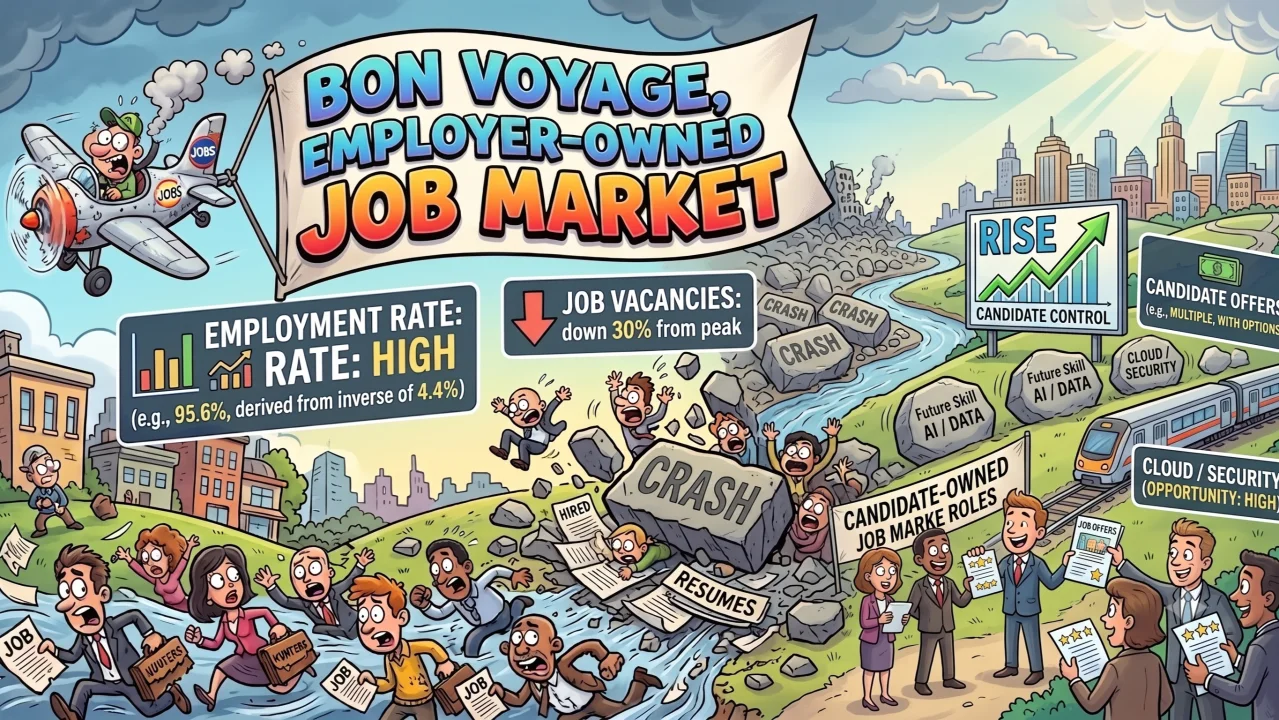
A person doing deliveries while applying for professional roles may count as employed while still experiencing a long and exhausting search for work in their field. Having some income and regaining a sustainable career are different outcomes. The headline unemployment rate cannot tell us everything about that gap.
For context, the ABS reported seasonally adjusted unemployment of 4.6 per cent in August 2026. Jobs and Skills Australia's 2025 AI study found generative AI more likely to augment work than replace it outright, while anticipating changes to tasks and skills. Neither finding establishes that AI is the cause of years-long job searches, and neither guarantees an individual an easy route back into their profession. ABS labour market release; JSA's national AI study.
Years of inflation make that uncertainty harder to carry. A drawn-out search consumes savings while food, housing and transport still have to be paid for. Even when inflation slows, the earlier price increases do not automatically reverse. The cumulative pressure can make immediate platform income feel necessary rather than optional.
Inflation, interest rates, business demand and hiring decisions can interact, so I would not attribute every prolonged search to AI or inflation alone. My point is about how those pressures are experienced together: confidence in future work weakens while the cost of waiting remains high. Delivery offered me another source of earnings, but it also exposed me to a different set of rules, costs and platform dependencies.
That is why the rights discussed here matter. People turning to gig work for financial resilience still need fair conditions in the work that is helping them get through the uncertainty.
The software was already doing managerial work
Calling every early platform an “AI boss” would be misleading. Many systems relied on rules, rankings and optimisation rather than today's generative AI.
The more useful term is algorithmic management. The International Labour Organization describes how software can organise, allocate, monitor and evaluate work, including through systems that do not use AI. ILO overview.
From a worker's perspective, the practical questions are familiar:
- Who gets offered the next task?
- How is performance assessed?
- Why did my earnings change?
- What triggered a warning or restriction?
- Can a human explain and review the decision?

Algorithmic-management illustration supplied for this article. See the ILO topic page for its research and resources.
These questions do not stop at the restaurant door. They travel quite easily into an office.
Australia's long road from apps to enforceable standards
The Australian story is not that gig workers had no rights until 2026. Existing laws could apply, and individual disputes sometimes established important protections. Nor does one delivery order resolve the conditions of every driver, freelancer or platform worker.
The point is narrower and more revealing: building a specific framework for this model of work took years, and winning an operative order took further work after the legislation changed.
A timeline of the gap
- 2012: Uber begins operating in Sydney. This marks an early Australian platform milestone, not the launch date of every rideshare or food-delivery service. Uber.
- 2018–2019: the TWU pursues cases and presses for regulation. Its contemporary accounts document Foodora disputes, calls for industry rules and a 2019 challenge involving an Uber Eats worker. This was already a sustained dispute about pay and access to work, years before the new framework. 2018 campaign; 2019 case.
- 26 August 2024: new regulated-worker powers commence. The Fair Work Commission gains functions including setting minimum standards for eligible employee-like platform workers. A power to make standards is not itself the same as an operative pay order. Commission overview.
- 28 August 2024: the TWU files its on-demand delivery application. The formal process then includes submissions, a proposed agreement with Uber Eats and DoorDash, and hearings. TWU case timeline.
- 26 February 2025: unfair-deactivation applications become available to eligible workers. Eligibility and procedural requirements apply; this is not an automatic remedy for every closed account. Commission announcement.
- 17 August 2026: the delivery order starts operating. Made on 11 August, the Interim On-Demand Delivery Employee-like Worker Minimum Standards Order covers specified delivery work and the relevant platform operators. Commission case record.
The application-to-operation period alone was almost two years. The broader history spans much longer.
That matters when someone says regulation will catch up with AI. Perhaps it will. The question is what happens to workers while everyone is waiting.
What the TWU helped win, and what the headline can hide
The TWU's role is central to this story. It represented workers in disputes and was the applicant in the minimum-standards proceedings. The Commission's public case record identifies that role directly. FWC proceedings.
The result also depended on legislation, evidence, negotiations, public consultation and the Commission's decision. Describing it as a union win should recognise the workers behind the campaign without pretending one organisation could change the law on its own.
The order includes a pay safety net and provisions on records, consultation, insurance, disputes and delegates' rights. Its hourly floor is calculated over engaged time, rather than guaranteeing payment for every hour a worker is logged on waiting for an offer. That distinction changes what an hourly headline means in someone's actual working day. Fair Work Ombudsman explanation.
“Interim” also needs explaining. The order is operative, with review linked to related delivery proceedings. It is not merely an unenforceable proposal. Commission case record.
This is progress, not the end of the story. Standards still need to be understood, enforced and improved. But they show the difference between asking a platform to be reasonable and having enforceable rules to point to.
The lesson is not simply that protection took a long time. It is that workers had to build the power to obtain it.
The experiment was happening under our noses
Perhaps we have been watching a vast experiment in organising work without recognising how far its methods could travel. The analogy between gig work and AI labour is now more than a thought experiment: Uber itself sells services that connect human workers to AI development.
In its 20 June 2025 announcement, Uber described expanding Uber AI Solutions through a digital-task network serving businesses. It explicitly connected its gig-work model to AI, drawing on the infrastructure it already used for identity checks, payments and task management. The talent it described included people with expertise in coding, finance, law, science and languages.
Uber's annotation services include creating prompts and responses, comparing model outputs and evaluating their quality. Human judgement remains part of the machinery behind apparently automated intelligence.
There is also a more direct connection to the existing driver workforce. Uber's Digital Tasks pilot describes optional work for selected US drivers and couriers inside the Driver app, including voice recordings, document submissions and image uploads. Availability depends on client demand. That is a specific pilot, not evidence that every driver or Australian account can access it.
The progression is striking:
- A platform coordinates people moving passengers and food.
- Similar infrastructure coordinates people producing and assessing data.
- That human work helps build or evaluate AI systems used in other work.
This does not establish that every task trains a worker's own replacement, or that gig work was secretly designed for this outcome. It does show that the organisational model can move from physical services into intellectual tasks.
The gig economy is not only a precedent for AI-mediated work. It is becoming part of the workforce that makes AI possible.
That sharpens the question for professional workers. Expertise may remain valuable while the way it is bought changes: a project, a rating task or a batch of judgements instead of an ongoing role. The issues the TWU has been fighting over, including reliable pay, transparent decisions and a meaningful voice, become relevant well beyond the road.
From piecework to token work
Now consider the emerging professional toolkit.
Open an AI assistant. Start a coding agent. Ask another tool to research a problem. Generate a prototype. Review the results. Then encounter a usage limit.
Wait, change tools or pay for more capacity.
The analogy with gig work has limits. An AI provider is not necessarily your employer, and buying a subscription does not make you an employee-like platform worker. A quota warning is not an unfair dismissal.
Nevertheless, a new dependency can emerge. If your deadlines and workload assume access to AI, the terms of that access become a working-conditions issue.
A worker may have time, ideas and an urgent task, yet lack the approved compute needed to complete it in the expected way.
The worker has become rate-limited.
For a freelancer, that can mean another cost of doing business. For an employee, it raises a different question: if the employer expects AI-assisted output, who pays for the tools, training and time needed to use them properly?
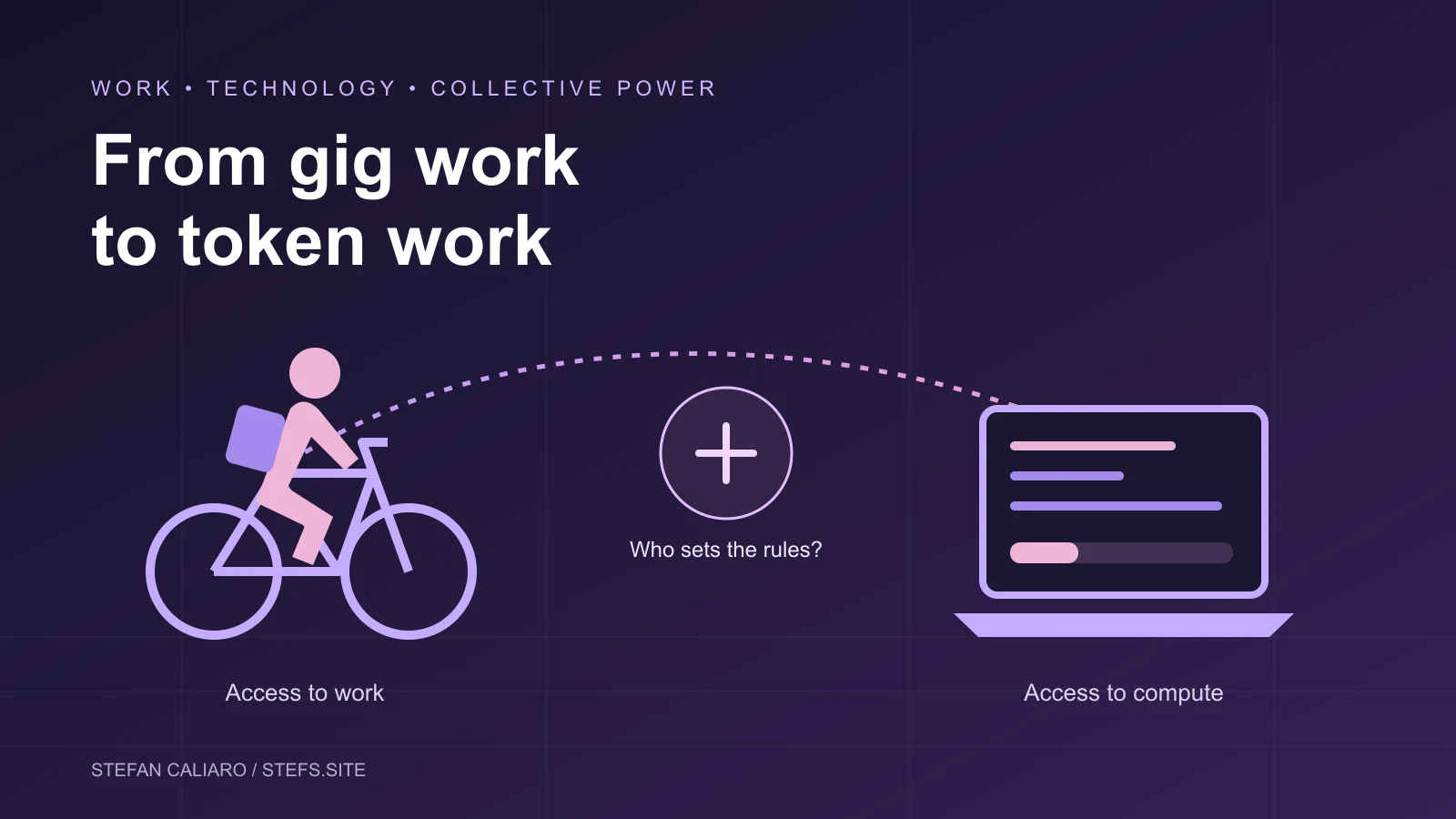
Different working arrangements, a shared question about control. Original illustration for stefs.site.
Compute inequality is a workplace question
Imagine two equally capable developers.
One receives an approved AI environment, ample usage capacity, training and time to verify results. The other has a free account, uncertain data rules and the same delivery targets.
That is a hypothetical example, but it exposes an important distinction: human skill and access to productive infrastructure are not the same thing.
A fair workplace conversation would ask:
- Are the tools available to everyone expected to use them?
- Are subscriptions and approved work expenses paid by the employer?
- Do targets account for verification, errors and service interruptions?
- Can staff explain why a particular task needs more time or compute?
- Are people being assessed on useful outcomes, or on misleading usage metrics?
The risk is not just that someone has a better subscription. It is that unequal access becomes invisible while performance comparisons remain very visible.
White-collar workers already have unions
One organisation worth knowing about is Professionals Australia, formerly APESMA.
It is a union representing a range of professional workers, including engineers, scientists, IT professionals, architects, pharmacists and managers across different industries. Its technology division explicitly raises concerns about rushed AI adoption, workload and worker involvement. Who it represents.
This does not mean it is the appropriate union for every person with an office job. Coverage depends on the occupation, employer and industry. Other unions represent many white-collar workers, so checking the right coverage matters.
But the larger point is easy to miss: professional qualifications and collective representation are compatible. Being technically skilled does not give an individual much control over a company-wide monitoring system, a redundancy program or a new productivity target.
The connection to the TWU is not that all workers face identical conditions. It is that individual expertise alone may not be enough to influence rules set far above the individual.
A practical agenda for professional workers could include:
- consultation before AI changes roles or performance assessment;
- clear boundaries on prompt logging and workplace surveillance;
- meaningful human review of consequential automated decisions;
- employer-funded tools and training where AI use is expected;
- workload targets that include checking and correcting generated work;
- a voice in how productivity gains affect staffing, pay and working time.
These are proposals for workplace negotiation, not a claim that every item is already a universal legal entitlement.
The productivity ratchet
I am optimistic about what these tools can make possible.
An individual can prototype an application, explore a dataset or test a business idea with less dependence on a large team. A small organisation can attempt work that would previously have been out of reach.
That can create real agency. It can also create a ratchet.
A task that becomes faster once may become the new baseline forever. Time saved on one report can turn into an expectation to produce three. A tool introduced as optional assistance can become an unstated requirement.
We should therefore ask two questions together:
What can AI help us produce? And who gets to decide what happens to the time it saves?
The OECD's 2025 research on algorithmic management shows that this discussion extends beyond delivery platforms. Its survey of employers across six countries examines adoption in conventional workplaces, perceived benefits and concerns about accountability, transparency and worker wellbeing. OECD research.
This is already a workplace-governance discussion, not just a prediction about future robots.
The office could become another platform
Imagine a system breaking a project into units:
- investigate a bug;
- review a security finding;
- answer a customer;
- update documentation;
- approve a deployment.
Some units go to employees, some to contractors and some to AI agents. The software assigns priorities, measures completion and recommends who gets the next task.
That scenario is not a prediction that every profession will become gig work. It is a way of asking where managerial power moves when more of the workflow becomes software-mediated.
The European Union's Platform Work Directive addresses algorithmic-management transparency and human oversight in platform work. It provides a useful comparison, although its scope should not be confused with a blanket set of protections for all office AI use. Council of the EU overview.

The Australian lesson is to ask about accountability early, before an opaque process becomes too entrenched to question.
What if higher productivity eventually means less human work?
There is no need to treat mass technological unemployment as a settled outcome. AI may change tasks, create new demand and increase the value of some forms of human judgement.
But it is reasonable to consider what happens if fewer paid hours are needed to produce the same output.
Universal Basic Income is one possible response, not an inevitable destination. Other possibilities include:
- shorter standard working weeks;
- stronger income support and transition assistance;
- portable benefits;
- public services and training;
- mechanisms that share productivity gains more broadly.
Finland's basic-income experiment is useful precisely because it produced a nuanced result: limited employment effects alongside improvements in reported wellbeing. It was an experiment involving unemployed participants, not proof of how a fully universal national scheme would work. Kela evaluation.
Australia also needs to be careful about expecting retirement savings to absorb every disruption. Superannuation has restricted access before retirement, with particular early-release pathways. Moneysmart guide.
If displaced workers were simply expected to spend their future retirement security to survive a technological transition, that would raise a distribution question: why should their future selves bear the cost while productivity gains accumulate elsewhere?
Universal Basic Compute?
Another possibility from this debate interests me: public access to useful AI capacity.
Think of libraries offering approved AI tools, students receiving access through education, or jobseekers getting help to use capable systems without adding another subscription bill.
Call it Universal Basic Compute, if you like. It is a proposal to explore, not an existing universal entitlement or a substitute for income.
The distinction is simple:
- Basic income asks: can people afford to live?
- Basic compute asks: can people access tools that may increasingly shape their ability to learn, create and participate?
Providing tools would not, by itself, fix unequal bargaining power. A delivery rider with a better bicycle still needs fair conditions. A professional with more AI credits may still need a say over workload and evaluation.
We do not have to wait another decade
The gig economy demonstrated both the value of easier access to work and the hazards of concentrating control inside platforms.
Australia's delivery standards were not an automatic upgrade delivered alongside a new app version. They followed years of worker organising, legal disputes, political change and formal proceedings. The TWU's campaign is a reminder that institutions can change, but people have to do the work of changing them.
For white-collar workers, Professionals Australia and other relevant unions offer an existing starting point for collective representation. The conversation does not need to begin only after an account is restricted, a role disappears or an unchallengeable productivity score is introduced.
The question is larger than whether AI will take a particular job.
Who sets the rules when software shapes our work, and who shares in the productivity it creates?
If the gig economy has taught us anything, it is that we should start answering that question while the new system is being built.
Further reading
- FWC: TWU minimum-standards proceedings and the operative delivery order
- Fair Work Ombudsman: delivery-order coverage and conditions
- TWU: food-delivery campaign and case timeline
- Professionals Australia: membership and occupation enquiries
- ILO: algorithmic management in the workplace
- OECD: algorithmic management research
Australian policy references checked on 1 October 2026. The comparisons and proposals about future AI-mediated work are the author's analysis.
Thanks for reading.
Get in touch ↗



Join the conversation
Comments and reactions use GitHub. Sign in to join in, and keep the discussion thoughtful and respectful.
View discussions on GitHub ↗