In this article
24 November update (Sydney time). NVIDIA announced on 23 November that Jensen Huang has been reinstated as president, CEO and a board director, effective immediately, following a unanimous vote. Harvey Jones remains board chair, and Colette Kress continues as CFO. The board said discussions with Huang satisfied it about his candour and ability to lead; it also said input from senior US government officials gave it confidence his reinstatement posed no national-security risk. Those are the board’s stated assessments, not a published investigative finding. NVIDIA says the independent directors’ committee and its outside counsel will complete their investigation as planned; his return does not end that process. ABC’s report. AP also reported the reinstatement.
For me, his return sharpens the question this article began with: can NVIDIA preserve its founder’s strengths while applying accountability consistently? The earlier reporting below records the resignation and the board’s subsequent refusal to reinstate him, positions now superseded by this announcement.
On 12 November 2026, NVIDIA announced that Huang had resigned as chief executive, president and board director, effective immediately. Finance chief Colette Kress was appointed interim CEO while retaining her CFO responsibilities, and longtime director Harvey C. Jones became the company's first-ever board chair. A search for a permanent successor began.
I got my start in IT before any formal training, thanks in part to a Packard Bell PC sold in 2000 with Windows Me and an NVIDIA GeForce2. In 2011 I upgraded to a Gigabyte NVIDIA GeForce GTX 570 with 1,280 MB of GDDR5 VRAM. I moved to an Intel Mac in 2014 and now use an M-series Mac. Even Intel, synonymous with PCs when I started gaming, later turned to Washington, SoftBank and NVIDIA for backing. US government agreement · Intel annual report · Intel's third-quarter results.
To Jensen and the NVIDIA team: thank you for the good old days of gaming and for helping make today’s AI tools possible. That gratitude can coexist with accountability. I keep coming back to one question: how much of NVIDIA’s judgement, influence and ability to get things done can the company carry forward without him?
Video summary
A video summary to accompany this article.
A personal scandal becomes a governance and security test
Timeline of the reporting and NVIDIA’s response
- 29 October: The New York Times broke the story of Huang’s close relationship with Alice Huang, a business executive associated with Megaspeed whom US officials reportedly suspected of working with Chinese intelligence. The Times published follow-up reporting on 6 November.
- 8–10 November: Huang acknowledged being unfaithful. NVIDIA announced an independent investigation and subsequently confirmed outside legal advisers would lead it. The board said it had no reason at that point to believe national security or company secrets had been compromised.
- 11–12 November: The Times reported a separate alleged relationship involving a senior employee. NVIDIA announced Huang’s resignation the following day. The Guardian’s timeline · Warren and Coons’s letter.
Huang’s apology did not name a partner. His acknowledgement and the intelligence allegations are separate, and the transition announcement did not report a completed finding.
The first report preceded the 3 November US midterms. Democrats won both chambers, and NVIDIA announced Huang’s departure nine days after the election. The sequence does not establish that the election influenced the timing. AP’s account of the congressional race calls.
Why Huang wanted NVIDIA to engage with China
Huang defended engagement with China in a Bloomberg interview. NVIDIA had already sought licences to sell H20 chips there and later told investors it was effectively shut out of China’s data-centre computing market at the end of fiscal Q2 2027. The company warned that losing access could help competitors build a larger developer and customer base. NVIDIA's H20 update · NVIDIA's quarterly filing.
Megaspeed and the reported US$12 billion in chip orders
17 November update (Sydney time). The Wall Street Journal reported that Singapore-based Megaspeed arranged nearly US$12 billion in NVIDIA chip orders for companies in China between March 2024 and June 2025. The records leave the number of chips delivered and their final destinations unresolved. Megaspeed told the Journal it operates lawfully and structures its supply chain to comply with US export controls. NVIDIA said it works to prevent smuggling. Read the Wall Street Journal investigation.
A senior Indonesian official told The Straits Times that police searched Megaspeed’s Indonesian office at the FBI’s request and found server racks but no GPUs. The search covered one location. The Next Web said it had not independently verified the account. The Straits Times report · The Next Web coverage.
19 November update (Sydney time). In a joint statement dated 16 November, Commerce and Justice said Commerce opened its Megaspeed inquiry in 2024, requested NVIDIA sales records in May 2025 and conducted an end-use check in Singapore that June. NVIDIA put Megaspeed on its “no sell” list in June 2025 and Justice subsequently took the lead in the criminal investigation. US agencies’ statement.
26 November update (Sydney time). The US Bureau of Industry and Security added Singapore-based Megaspeed and six other entities to its Entity List, citing a significant risk that advanced computing items could be diverted to unauthorised users or uses. The rule requires licences for items subject to US Export Administration Regulations and presumes applications will be denied. Federal Register rule.
NVIDIA’s manufacturing supply chain remains heavily concentrated in Asia. TSMC has produced Blackwell wafers in Arizona, while some advanced packaging still takes place in Taiwan. Texas adds capacity for system assembly. Moving one stage does not move the entire supply chain. Semiconductor Industry Association · NVIDIA's annual report · NVIDIA on Arizona wafer production · NVIDIA on US system assembly · Tom's Hardware on advanced packaging.
NVIDIA's greatest single point of failure
In cloud engineering, we design for failure by spreading responsibility across components and documenting how to recover. I see a similar problem at NVIDIA. Huang said at Stripe Sessions that 60 leaders reported directly to him. That gave him a clear view of the work, but during his absence someone still had to take ownership of those decisions and relationships. Huang's Stripe Sessions interview · Reuters on NVIDIA’s flat structure · TechCrunch's interview with Ann Lipton and Todd Henderson.
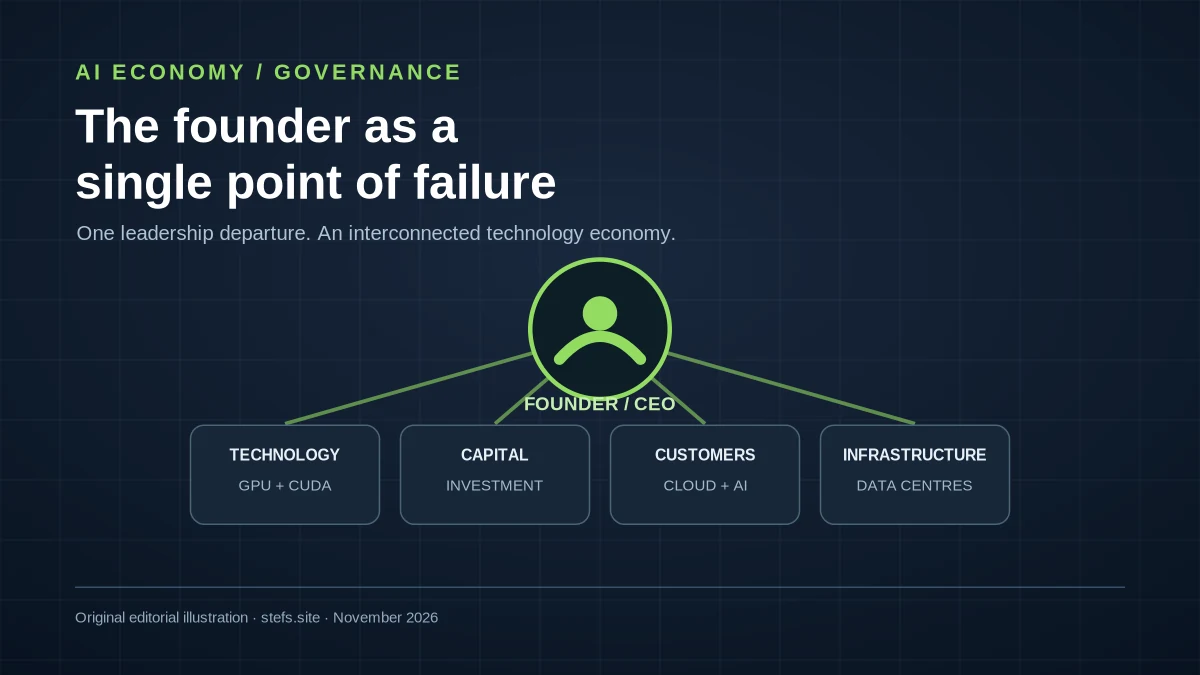
Musk claimed some supply arrangements rested on Huang’s handshake and predicted some would fall away. He did not identify the agreements. NVIDIA disclosed US$279 billion in supply and capacity commitments as of 26 July, and the board said it expected customer commitments to continue without interruption. Those disclosures leave open which arrangements Musk meant. Musk's post on X · NVIDIA quarterly filing · NVIDIA transition announcement.
The board also faces an oversight test. NVIDIA’s proxy identifies its independent directors and says Huang’s children did not report directly to him or have their compensation set with his involvement. Family employment deserves scrutiny on the same terms as any other potential conflict. NVIDIA's 2026 proxy disclosures · Breakingviews on NVIDIA’s governance.
Board share sales deserve scrutiny too
Tom’s Hardware reported on 15 November that director Mark Stevens sold about 4.2 million NVIDIA shares before the scandal, for roughly US$947 million, rounded to US$1 billion in its headline. Citing Moneywise, it said the sales were not under a Rule 10b5-1 trading plan. That is reporting about the transactions, not a finding of insider trading: timing alone does not establish advance knowledge or wrongdoing. For me, accountability should extend to the board’s disclosures and trading controls as well as its treatment of the founder.
Would an ordinary employee receive the same empathy?
Watching the clip shared by Alvin Foo, I thought this was the saddest I had seen Musk. That is my impression of his demeanour, not a claim about his private feelings. The post presents his objection to Huang’s departure through a comparison with removing Michael Jordan from a winning Chicago Bulls team.
The sentiment that people make mistakes resonates with me. But if Huang were not a celebrated CEO and co-founder, would Musk and others extend him the same understanding? An ordinary employee deserves compassion, a fair process and proportionate consequences too. Exceptional achievements should not buy exemption from accountability, and empathy should not depend on someone’s commercial value.
Before the reversal: the campaign for Huang’s return
18 November update (Sydney time). Huang posted on X on 17 November, thanking supporters and saying he would be honoured to return if NVIDIA’s board judged it to be in the company’s best interests. Digital Trends described it as his first public statement since resigning and reported his commitment to cooperate with the independent investigation. His willingness to return leaves the decision with the board. Digital Trends’ report.
18 November update (Sydney time). Chair Harvey Jones said on NVIDIA’s 17 November earnings call that the board had unanimously accepted Huang’s resignation and did not intend to reinstate him as CEO. That public statement supersedes the earlier anonymously sourced account of the board’s position. Supporters’ Silicon Valley “war room” campaign continues to form part of the debate about founder dependence. AP on Jones’s statement · Reuters’ earlier reporting · AP on the campaign · Reporting on the FT account · The Information.
Business Insider reported more than 100,000 petition signatures in its headline and about 97,000 in its earlier snapshot, with organisers removing fake entries. Separately, WIRED reported over 1,600 comments on an internal employee suggestion-box post. Those figures measure different things, and the public signature count cannot tell us how many verified employees or shareholders back reinstatement. Business Insider's 14 November report · WIRED reviewed internal correspondence.
Scott Bessent urged NVIDIA to look outside the company for its next CEO. House committee chairs announced on 17 November that Huang and general counsel Tim Teter had agreed to transcribed interviews on 1 and 2 December, respectively. House confirmation · Earlier request · Reuters on Bessent’s remarks.
25 November update (Sydney time). The US Senate Banking Committee lists Huang as the witness for its public hearing on US export controls on 3 December in Washington (4 December in Sydney). Separately, California’s attorney-general served NVIDIA with an investigative subpoena on 19 November seeking information about whether advanced chips or confidential information reached China and whether the company misled investors or the public. Those questions remain under investigation. Senate hearing notice · California Department of Justice.
20 November update (Sydney time). In an 18 November letter to Kress, House Energy and Commerce chair Brett Guthrie requested a briefing by 2 December on NVIDIA’s export-compliance safeguards. This is a separate oversight request, not a finding of wrongdoing or confirmation that a briefing has occurred.
18 November update (Sydney time). NVIDIA announced a standing committee to oversee national security, export compliance and global trade risk. The relevant teams report to the committee and to Kress for day-to-day operations. The committee announcement did not release findings from the investigation. NVIDIA’s announcement.
Reuters also relayed a Wall Street Journal report that the SEC was investigating whether NVIDIA’s disclosures misled investors. The scope was unclear, the SEC declined comment and NVIDIA had not immediately responded. Reuters on the reported inquiry.
A US$50 billion rival? A prediction, not an announcement
21 November update (Sydney time). Coverage of a possible Huang-led semiconductor venture traces back to Semafor reporter Rohan Goswami’s prediction on Prof G Markets. TMGM’s account explicitly identifies the US$50 billion figure as his forecast, not a proposal announced by Huang. I found no confirmation of a launch or secured funding. The distinction matters: confidence in a founder’s network is not evidence that a new competitor exists.
He left the boardroom, but not necessarily his NVIDIA investment
His temporary departure from the executive and board roles did not automatically change Huang’s shareholding. NVIDIA’s proxy reported 870.6 million shares, or 3.58%, beneficially owned as of 23 March 2026, including trusts and a foundation. That historical figure does not mean he held every share personally. NVIDIA's May 2026 proxy statement.
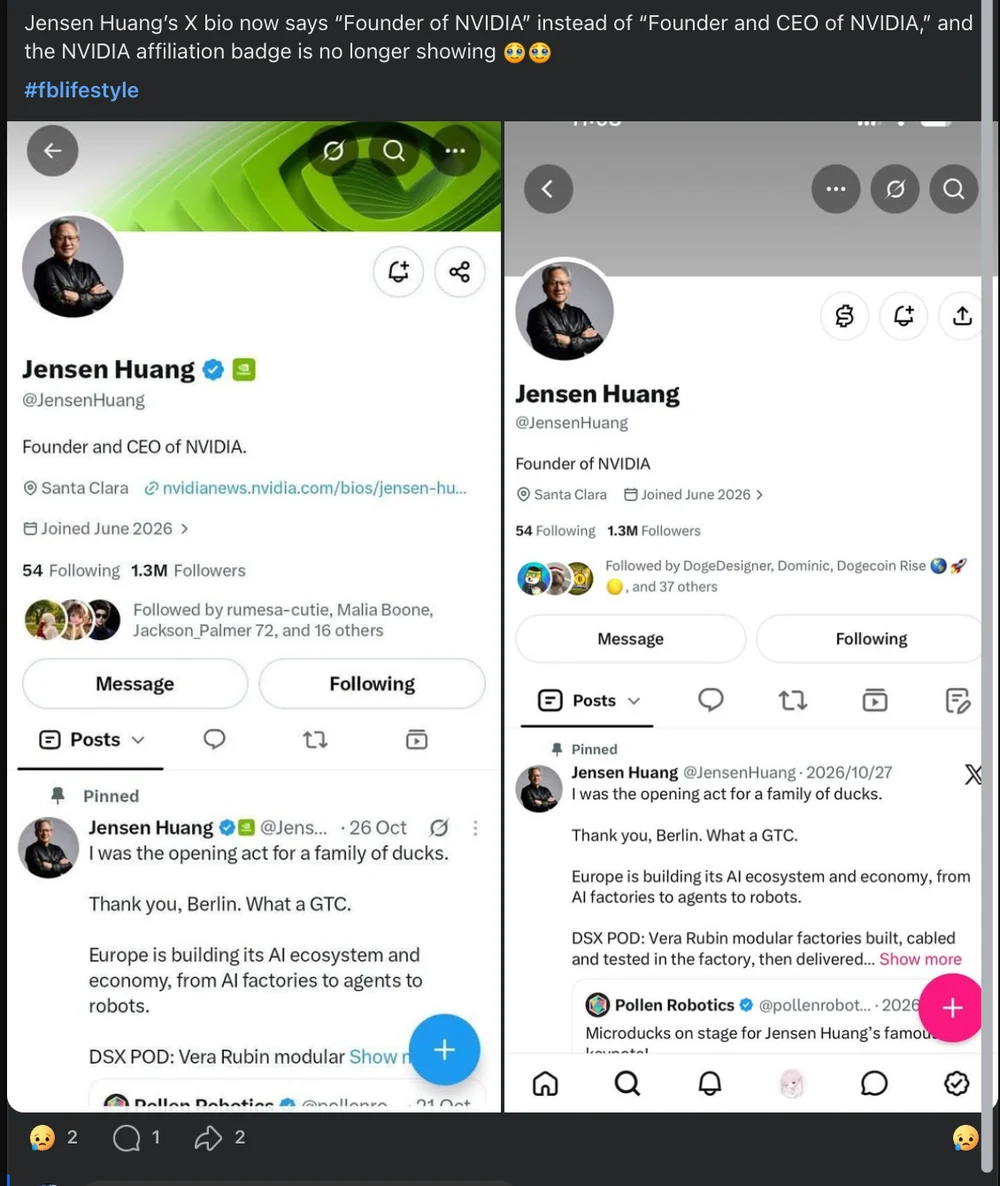
The supplied X screenshots show the bio changing from “Founder and CEO of NVIDIA” to “Founder of NVIDIA”, with the NVIDIA affiliation badge absent in the later capture. The comparison does not establish when or why it disappeared. Jensen Huang’s X profile.
The AI economy's circular-financing question
Two direct customers accounted for 36% of NVIDIA’s fiscal 2026 revenue. NVIDIA also announced partnerships intended to mobilise more than US$500 billion in third-party capital over time for AI infrastructure. When a chip supplier helps finance businesses that buy its chips, the question is whether end-user demand and cash flow can support the spending. NVIDIA's fiscal 2026 annual report · NVIDIA’s financing announcement · quarterly filing.
Futurism, drawing on Wall Street Journal reporting, asked whether financing smaller cloud providers could sustain demand and keep GPU prices high as component supply grew. Deliberate scarcity remains a hypothesis. Testing it would require evidence about inventory, allocations, orders and prices. Futurism’s article on GPU scarcity.
The stock-market sell-off: a warning, not a verdict
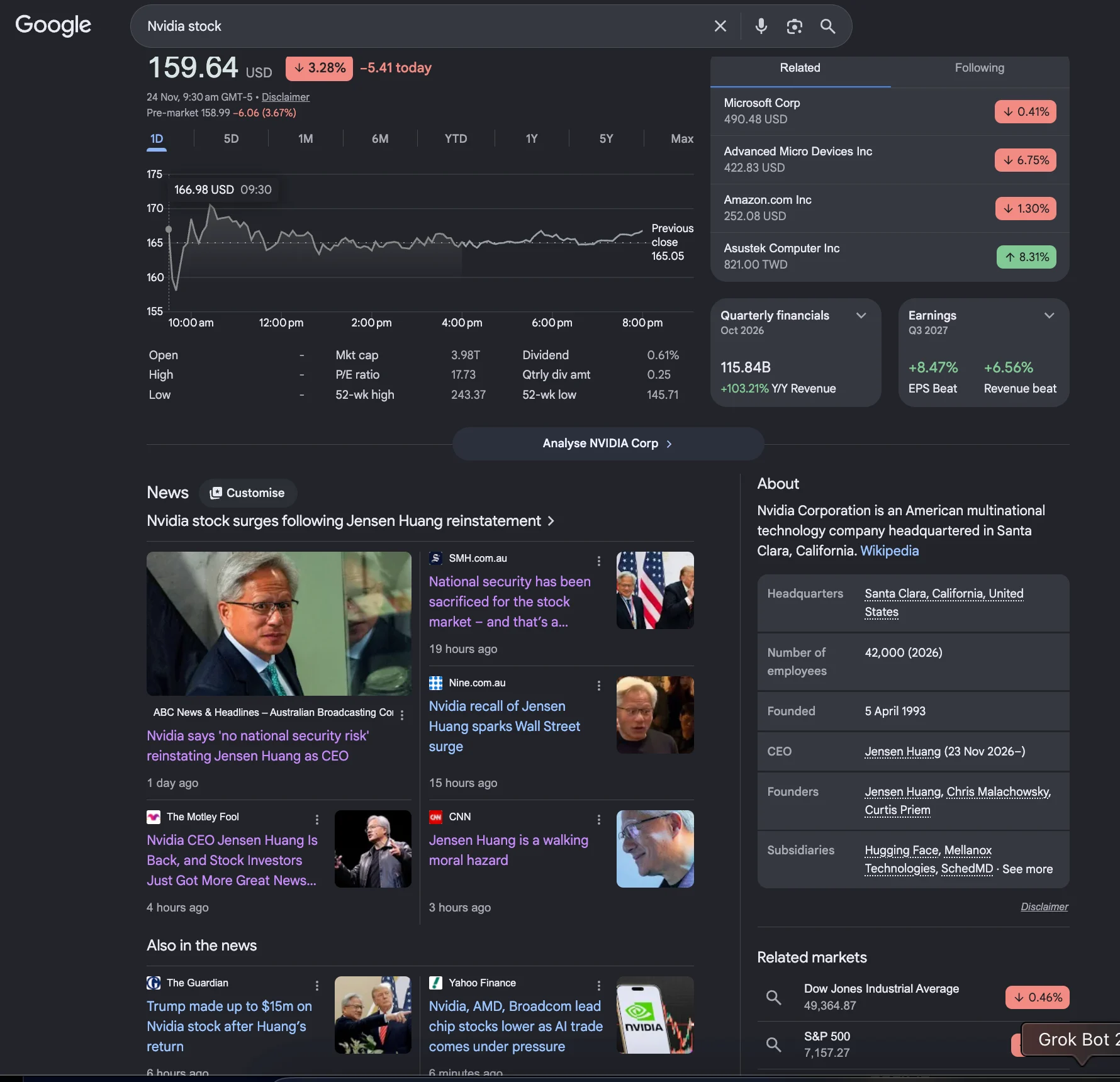
The 12 November US session was still open when I first published this. The Guardian recorded an early price near US$149.79, about 13.78% below the prior close, and estimated an US$888 billion drop in market value since the preceding Friday. The session low was US$148.80. The Guardian's live coverage · verified 11 November closing price of US$173.73.
The US closes tell a different story. From US$173.73 on 11 November, shares closed at US$166.19 on 12 November (down 4.34%) and US$162.85 on 13 November (down 2.01%), a 6.26% decline across both sessions. Stock Analysis's daily history.
Track the price in US dollars. Market data may be delayed.
What happens next will matter more than what happened this week
NVIDIA’s first earnings release under Kress reported US$115.8 billion in quarterly revenue, for a period ending 25 October, before Huang’s departure. It establishes the business inherited by the interim leadership. NVIDIA also announced expanded supply commitments with manufacturing partners. I’ll be watching whether those commitments translate into continued delivery and customer confidence. Official results · Supply-chain announcement · Earnings call announcement · Michiel Ecker’s commentary · My infrastructure resilience piece.
Huang’s achievements deserve recognition. His family deserves privacy. Accountability means establishing what happened and acting on it. The strongest legacy a founder can leave is a company that can succeed without them.
We never truly own anything
A founder can own shares and still lose the job that gave them authority. The reel stayed with me because it asks what we really control, and for how long.
Sources and the original posts discussed
Interviews, clips and commentary
I watched this Short before Jensen Huang left NVIDIA.
The following clips and posts reflect commentary and speculation during the story.
The timing is also the subject of this YouTube commentary. Why the Nvidia sex scandal leaked right now
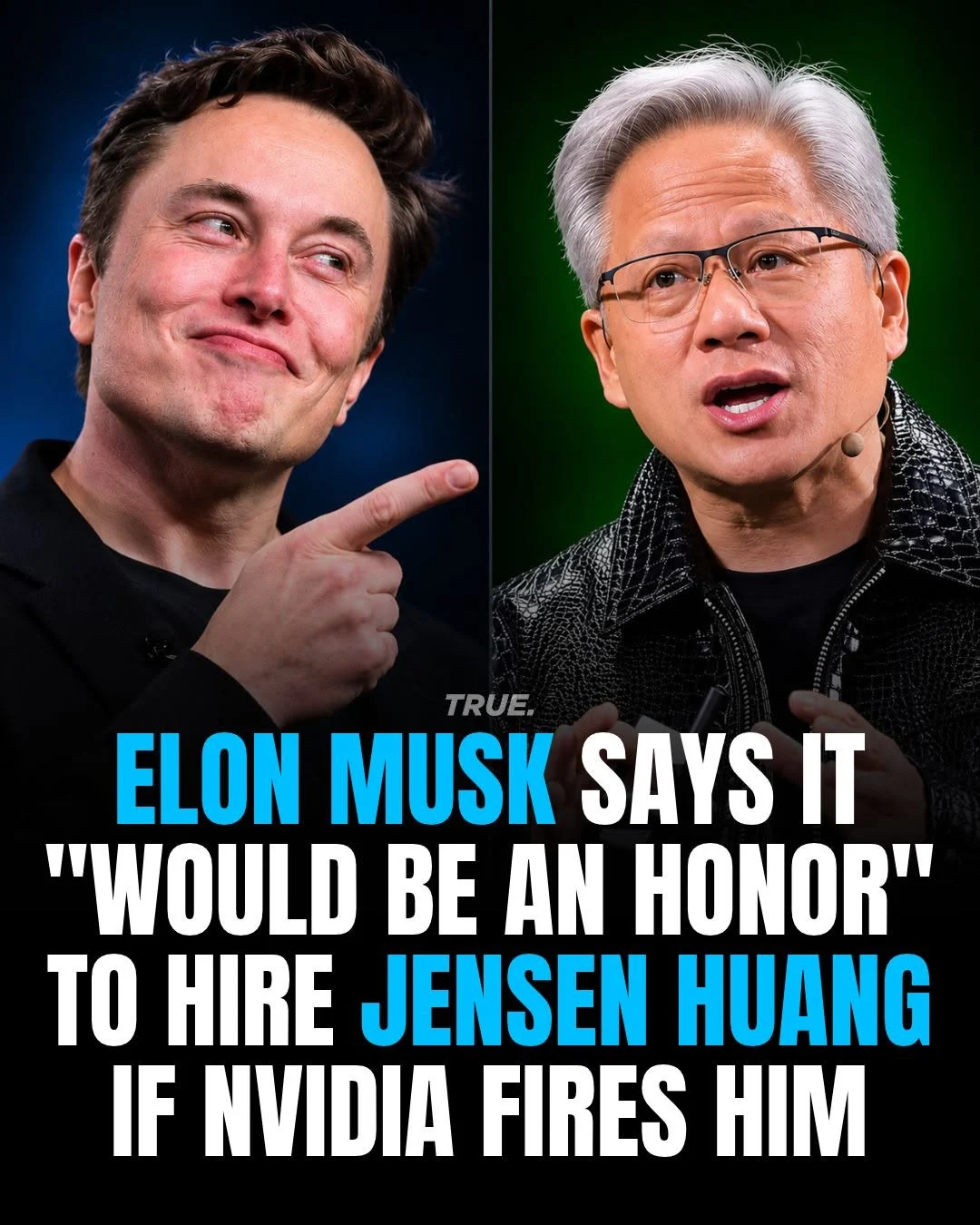
Musk said it would be an honour to hire Huang, without naming a role or making a formal offer. Steve Jobs’s return to Apple offers a historical comparison. About 12 years after Jobs left, Apple acquired NeXT for US$427 million and he returned, later becoming interim CEO. reported by Bloomberg and other outlets · Apple's annual filing.
The viral stock chart
The Ericnomics reel compares years of stock appreciation after executives’ relationship controversies. The dates span 2013 to 2021, and the figures cover different businesses and currencies. Its NVIDIA comparison ends on 6 November, before Huang’s public acknowledgement and resignation. These price returns cannot establish what caused the gains. reconstruction by The Breakdown.
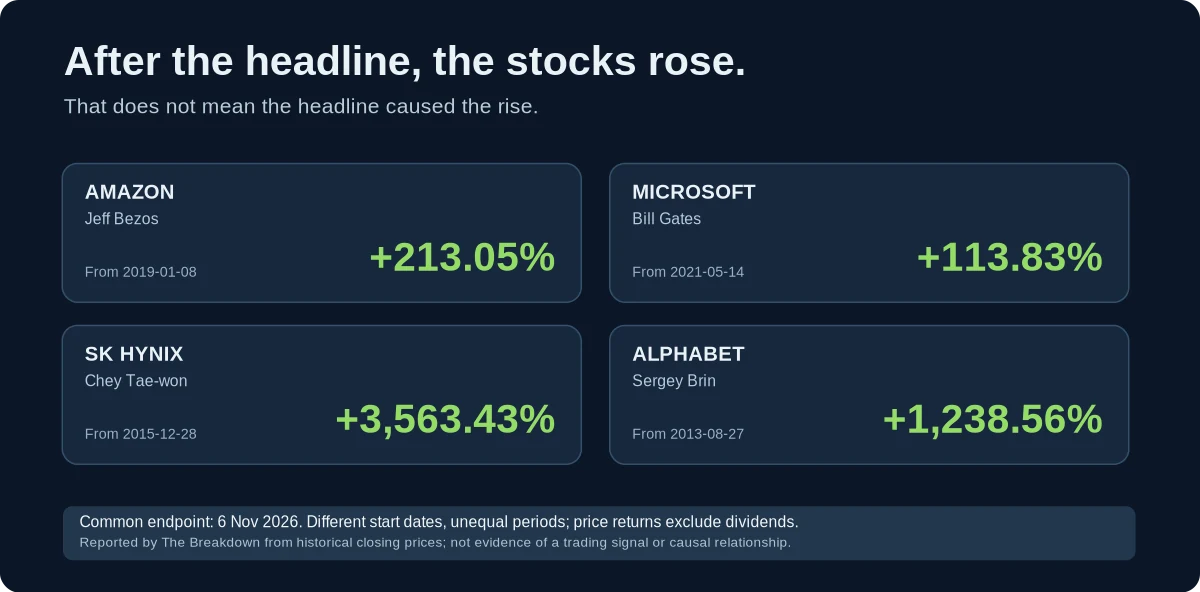
- Amazon: US$82.829 on 8 January 2019 to US$259.30, +213.05%. Price history.
- Microsoft: US$248.15 on 14 May 2021 to US$530.61, +113.83%. Price history.
- SK hynix: ₩30,900 on 28 December 2015 to ₩1,132,000, +3,563.43%. Price history.
- Alphabet Class A: about US$21.275 on 27 August 2013 to US$284.78, +1,238.56%. Price history.
Other social posts
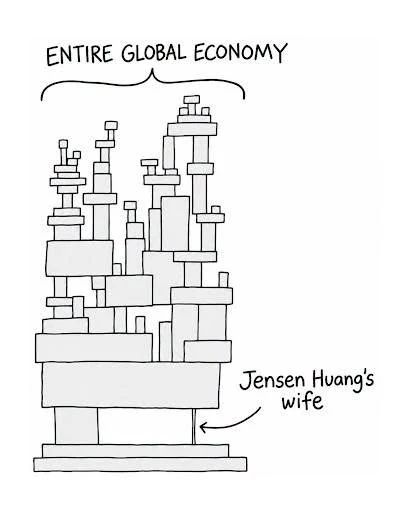
The LinkedIn post below speculates about Madison Huang’s succession prospects. I found no confirmation of a board decision or shortlist supporting it. The posts in the source list about a purported family statement and prospective employers are likewise unverified.
Originally published on 13 November 2026 (Sydney time). The market section preserves the intraday reporting and gives the completed-session figures separately.
Further sources and coverage
- California's general community-property rules
- CEO Brian Krzanich resigned
- VnExpress overview of technology billionaires' scandals
- Facebook discussion of possible employers (unverified)
- Coverage of the Saturday Night Live sketch
- Facebook post about a purported family statement (unverified)
- Earlier X commentary on the allegations (unverified)
- Denny’s statement and restoration update
- BBC/Reuters photograph accompanying the live coverage
- Reuters: Huang's departure and AI industry implications
Thanks for reading. About reader stats
Get in touch ↗Join the conversation
No account needed. Keep comments thoughtful and respectful. Your first comment is held for approval.




What should I write about next?
Have a question, a problem you’d like me to investigate, or a story worth exploring? I’d love to hear your ideas for a future post.
Suggest a topic in the comments or email me your idea. A short description and any useful links will help me get started.