How do Tech Companies Keep Relevant in the AI Age of LLMs, VR/AR and Future Tech?
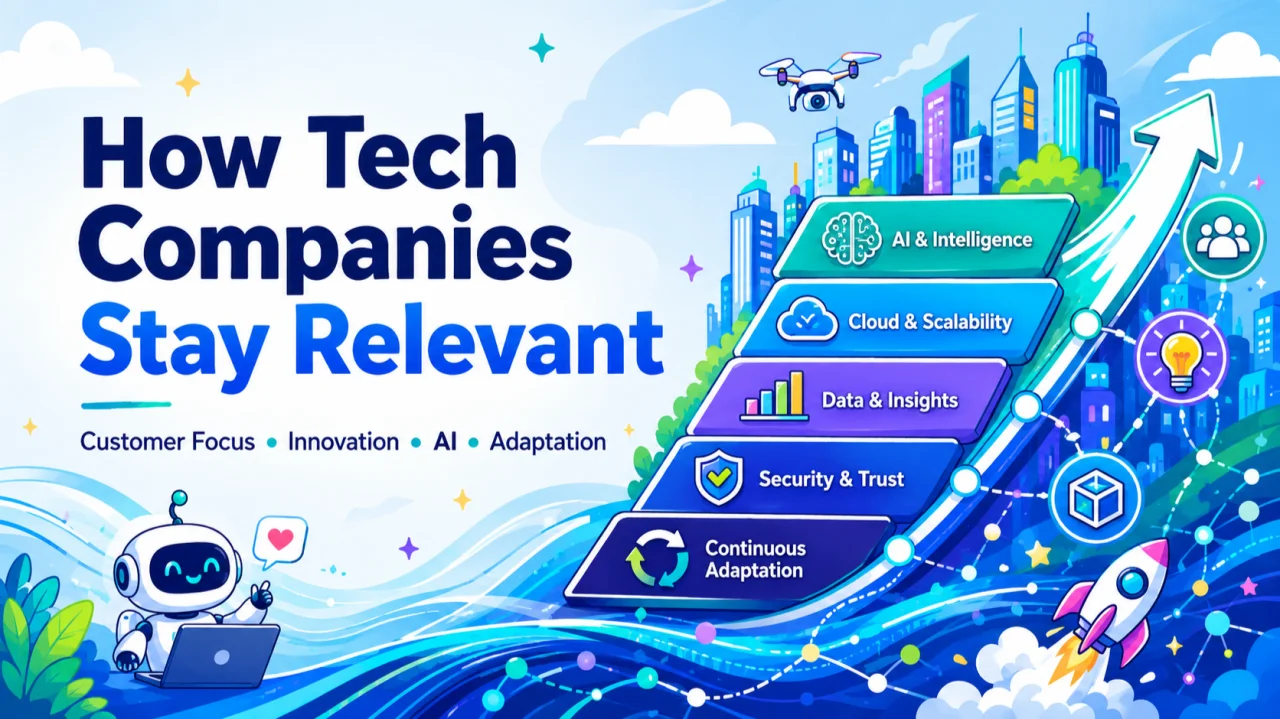
Tech companies stay relevant by continuously re-earning their usefulness. The ones that survive do not just “use new tech”; they keep matching technology to real customer pain, market shifts, and business outcomes.
The strongest pattern is this:
1. They stay close to the customer problem
Relevant companies do not obsess only over features. They ask: what painful, expensive, repetitive, risky or slow thing are customers trying to fix?
For example, cloud companies stayed relevant because customers wanted less infrastructure management. SaaS stayed relevant because customers wanted faster deployment and lower upfront cost. AI-native tools are now gaining traction because people want faster research, writing, coding, analysis and automation.
2. They move with platform shifts
Every major tech era creates winners and losers: desktop, web, mobile, cloud, SaaS, DevOps, cybersecurity, now AI/agentic systems. McKinsey’s 2025 technology outlook highlights frontier technologies such as AI, cloud, robotics, mobility, climate technologies and cybersecurity as areas shaping company strategy across sectors.
The companies that keep relevance usually ask early: “What does this new platform make possible that was previously too expensive, slow or difficult?”
3. They turn trends into useful products, not hype
This is where many companies fail. They announce “AI-powered” everything, but customers only care if it saves time, reduces risk, increases revenue, improves service or removes friction.
McKinsey’s 2025 AI survey notes that many organisations are still struggling to move from AI pilots to scaled business impact, and that value depends on strategy, talent, operating model, technology, data, adoption and scaling.
So relevance comes from implementation quality, not just trend adoption.
AlphaFold - The Most Important AI Breakthrough Ever Made (view original embed)
4. They rebuild their own operating model
Deloitte’s Tech Trends 2026 says AI is becoming a foundational enterprise capability, with organisations shifting from experimentation to scale.
That means relevant companies change how they work internally: product teams use AI, support teams use automation, engineers use better DevOps workflows, sales uses better data, and leadership measures outcomes instead of vanity innovation.
5. They protect trust
As tech gets more powerful, trust becomes a product feature. Gartner’s 2026 strategic trends include pre-emptive cybersecurity, digital provenance, and AI security platforms, reflecting the growing importance of security, authenticity and governance around AI, software and data.
This matters because customers will not stay with a company that is fast but insecure, cheap but unreliable, or innovative but careless with data.
6. They avoid becoming trapped by their old success
Big tech companies often become irrelevant when they protect legacy revenue too aggressively. They keep optimising the old model while a smaller competitor changes the rules.
Classic examples: Microsoft stayed relevant by shifting from Windows-first to cloud, Azure, GitHub, Teams and now AI. Apple stayed relevant by moving from computers to iPod, iPhone, wearables and services. Netflix stayed relevant by moving from DVDs to streaming, then original content. BlackBerry and Nokia struggled because the smartphone platform shift moved faster than their internal adaptation.
More recently, Google remaining relevant and highly profitable than even before with the advent of AI platforms like ChatGPT, Claude, Perplexity and more.
The 55-Slide Deck That Predicted AlphaFold, LLMs, and the Next Decade of AI (view original embed)
In March 2019, Demis Hassabis stood in front of an MIT audience and walked through 55 slides that laid out DeepMind’s entire theory of intelligence.
This was before AlphaFold 2. Before the LLM era at DeepMind. Before the Google Brain merger. Before most people in the room had any idea what was coming.
Six years later, the deck reads like a roadmap.
The AI Godfather: Why LLMs Are a Dead End for AGI (view original embed)
7. They keep talent sharp
Relevant tech companies keep learning loops alive: hiring people close to new markets, upskilling existing staff, giving engineers room to experiment, and letting product teams test fast. Cutting costs alone rarely creates relevance. Innovation needs capability, not just efficiency.
Disclaimer: Most of this article was written by ChatGPT Pro with 5.5 model with the prompt "how do tech companies keep relevant?". Articles and embeds added in myself along with the Google vs AI companies example.
Thanks for reading.
View the original discussion on LinkedIn ↗





Join the conversation
Comments and reactions use GitHub. Sign in to join in, and keep the discussion thoughtful and respectful.
View discussions on GitHub ↗